The music industry has always evolved with technology. From vinyl to streaming, every shift has come with winners, losers, and a scramble to adapt. But what’s happening now with artificial intelligence feels less like evolution—and more like disruption at an unprecedented scale.
AI is no longer just a creative assistant. It’s becoming an active participant in the music economy—one that can generate songs, imitate artists, and even distribute content faster than the artists themselves. The result is a system under pressure, where the boundaries between innovation and exploitation are increasingly blurred.
Artists are already feeling it. South African DJ Shimza recently raised concern after discovering that an AI-generated track—trained on snippets from his own online content—was released before he could even drop his original work. What once sounded like a futuristic scenario is now a lived reality for many creators.
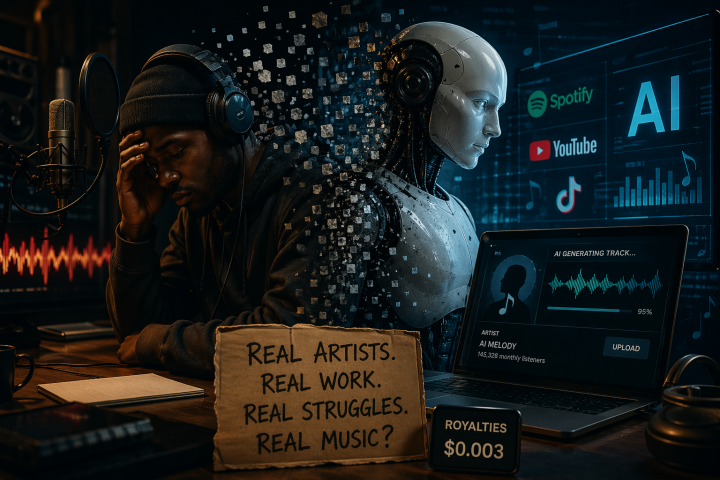
At the center of this issue is scale. AI tools can now produce thousands of tracks in a fraction of the time it would take a human artist. These songs can be uploaded, registered, and monetized across platforms with minimal oversight. In some cases, entirely fake artist profiles are created to push this content into the system, collecting royalties without any real creative identity behind them.
Even established musicians aren’t immune. Jazz artist Jason Moran was recently congratulated for releasing music he had never created. His name had been attached to an AI-generated project distributed on streaming platforms without his consent. While some of these tracks are eventually taken down, many remain online long enough to generate revenue and confusion.
Streaming platforms themselves are struggling to keep up. Services like Spotify and YouTube rely heavily on automated systems such as Content ID to manage copyright and ownership. But these systems, originally built to protect rights holders, are now being exploited. False claims, duplicate registrations, and fraudulent uploads are becoming more common—and more difficult to detect.
The economic impact is significant. As AI-generated music floods platforms, the total pool of royalties is spread thinner. Genuine artists earn less per stream, while discovery becomes more difficult in an oversaturated market. Platforms like Deezer have already reported tens of thousands of AI-generated tracks being uploaded daily, many of which appear designed not for audiences, but for revenue extraction.
Behind the scenes, tensions are rising between tech companies and major record labels. Industry giants like Universal Music Group and Sony Music Entertainment are pushing for stricter controls, arguing that AI-generated music should be confined to closed ecosystems. Meanwhile, AI developers are advocating for open distribution across platforms like TikTok and streaming services. At stake is control over the future supply of music—and the revenue that comes with it.
In Africa, the conversation is taking a slightly different tone. While the risks are clear, there is also a growing focus on building AI tools that reflect local cultures and languages. Startups like Korin AI are exploring how artificial intelligence can support creativity without erasing authenticity. At the same time, artists across the continent are experimenting with AI, balancing curiosity with caution.
Regulation, however, remains slow. In places like the United Kingdom, attempts to establish clear rules around AI training and copyright have stalled. Industry bodies have raised concerns, but comprehensive frameworks are still lacking. In the absence of regulation, platforms are left to create their own solutions—some more aggressive than others. Bandcamp has taken a firm stance by banning fully AI-generated music, while Apple Music is experimenting with transparency tools that indicate whether AI was used in a track’s creation.
These responses highlight a deeper divide. Some believe the system can rely on transparency and self-reporting, while others assume bad actors will continue to exploit any gaps that exist.
What’s clear is that the industry is entering a new phase—one where music is not just created, but manufactured at scale. The challenge is no longer just about protecting copyright, but about preserving value in an ecosystem where content can be generated endlessly.
For emerging platforms and markets, this presents both a risk and an opportunity. There is a chance to build systems that prioritize fairness, transparency, and artist protection from the ground up. Stronger verification processes, clearer policies around AI usage, and better royalty tracking could define the next generation of music platforms.
AI is not going away. It will continue to shape how music is made, distributed, and consumed. But as the technology advances, one question becomes increasingly urgent: can the industry build a system where innovation thrives without undermining the very artists it depends on?
Because in the end, the future of music shouldn’t just be automated—it should still be human.