
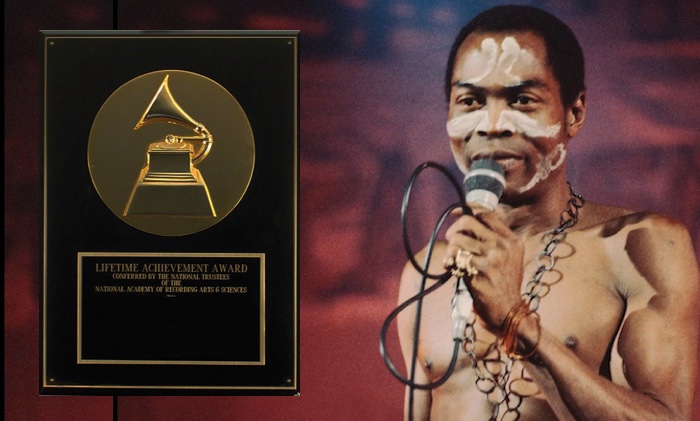
In a move that resonates far beyond the music industry, the Recording Academy has posthumously honored Afrobeat pioneer Fela Anikulapo-Kuti with the Grammy Lifetime Achievement Award. This recognition, while arriving decades after his passing, serves not as a late correction, but as a powerful, global affirmation of a legacy that has refused to be contained or quieted.
The award, one of the highest honors in music, begs the question: What does a Grammy mean for a man who famously rejected Western validation, who fought colonial structures, and whose very art was a weapon against the establishment?
Not Validation, but Vindication
For Fela, who during his lifetime would have likely greeted the news with a characteristic side-eye and a defiant riff from his saxophone, this award is not a validation of his genius. That was settled long ago in the crowded, sweaty shrine at 14A Agege Motor Road in Lagos, and in the hearts of millions across Africa and the diaspora. Instead, it reads as a vindication.
It is the formal, institutional acknowledgment that his towering musical creation—Afrobeat—is not just a genre, but one of the most significant cultural and political art forms of the 20th century. The Grammy confirms what we already knew: that Fela’s complex, polyrhythmic soundscapes, his searing lyrical critiques, and his fearless persona have irrevocably shaped the global music landscape.
Cementing the Bridge Between Sound and Struggle
The Lifetime Achievement Award solidifies the understanding that Fela’s legacy is indivisible. You cannot honor the musician without honoring the activist; you cannot celebrate the grooves without acknowledging the grievances that fueled them. Songs like “Zombie” (a satire on the mindless obedience of the military), “Sorrow, Tears and Blood” (documenting state violence), and “International Thief Thief (ITT)” (critiquing multinational exploitation) were not just hits—they were manifestos set to an irresistible beat.
This Grammy, therefore, elevates the idea that music of the highest artistic caliber can be, and perhaps must be, engaged with the world it inhabits. It places Fela’s work in its proper context: as a fearless chronicle of post-colonial African reality and a blueprint for artistic resistance.
Amplifying the Eternal Message
In practical terms, the award introduces Fela to new generations within the framework of music’s highest honor. It sends a new wave of listeners back to the source—to the sprawling 15-minute tracks, the intricate arrangements of his band Egypt 80, and the raw power of his live performances. It reiterates that his messages about governance, pan-Africanism, black pride, and social justice are not relics of the past, but urgent commentaries with profound relevance today.
Furthermore, it casts a brighter light on his continuing influence, which is everywhere: in the socio-political punch of Burna Boy and Seun Kuti’s music, in the sonic adventurousness of artists like Janelle Monáe and Kendrick Lamar, and in the very fact that “Afrobeat” (now often styled as Afrobeats) is a dominant force on global charts.
A Complex Crown for an Original
There is, of course, a beautiful irony in a Western institution honoring a man who dedicated his life to dismantling the cultural and political hegemony of the West. Fela would have appreciated the paradox. He might have seen it as the system finally catching up to a truth that moved on without its permission.
Ultimately, the Grammy Lifetime Achievement Award does not add to Fela’s legacy; it finally acknowledges its full, monumental scale. It places a formal, gilded frame around a revolutionary portrait that was already complete. The crown fits not because it was bestowed, but because Fela, the Abami Eda (the Strange One), has been the uncrowned king all along—ruling from the shrine, his music a timeless, unwavering force of nature, truth, and rebellion.